

Trading License Malaysia: Do You Need One and How to Apply (2026 Guide)
Last updated: 3 November 2026 | Reviewed by the iComSec corporate secretarial team
Quick answer: In Malaysia, a “trading license” usually means the business premises licence issued by your local council, such as DBKL or MBSJ. Most businesses operating from a physical premises need one, in addition to SSM registration. Majority foreign-owned trading companies may also need KPDN approval, commonly called a WRT licence, with at least RM1 million paid-up capital.
Many new business owners finish their SSM registration, sign a shop lease and start trading, only to receive a visit from the council enforcement team a few weeks later. The reason is simple: registering a company and being licensed to trade are two different things.
This guide answers the questions SME owners ask most about the trading license in Malaysia: what it is, who needs it, how to apply, what it costs, and what changes if your company is foreign-owned.
What Is a Trading License in Malaysia?
A trading license is a permission to carry out business activities at a specific location or in a specific sector. In everyday use, it refers to the licence issued by your local authority (Pihak Berkuasa Tempatan, or PBT) under its licensing by-laws, often called a lesen perniagaan or premises licence.
Depending on your business, “trading license” can mean one of three things:
| Type | Issued by | Who needs it |
|---|---|---|
| Local council business or premises licence | Your local council (for example DBKL, MBPJ, MBSJ, MBSA) | Most businesses operating from a physical premises |
| WRT licence (distributive trade approval) | Ministry of Domestic Trade and Cost of Living (KPDN) | Majority foreign-owned companies in wholesale, retail, import/export, F&B or franchise |
| Sector-specific licences or permits | Relevant regulator (for example health, customs or industry authorities) | Businesses in regulated activities such as food, cosmetics, pharmaceuticals or controlled goods |
Most SMEs only need the first one. Foreign-owned trading companies usually need the first two.
Is SSM Registration the Same as a Trading License?
No. SSM registration gives your business a legal identity. It does not give you permission to operate from a premises.
Think of it this way:
- SSM registration answers “Does this business legally exist?”
- A trading license answers “Is this business allowed to operate here, doing this activity?”
You normally need both. Our guide on business registration vs business licences explains the difference in more detail.
Who Needs a Local Council Trading License?
Any business that operates from a premises within a local council’s area generally needs a licence from that council. This includes shops, offices, warehouses, workshops, restaurants, salons and factories.
The exact rules depend on your council’s by-laws and your type of business. A few practical points:
- The licence is tied to the premises, not just the company. Opening a second outlet usually means a second licence.
- Your premises must be approved for that use. A unit zoned for residential use generally cannot be licensed for commercial trading.
- A registered office address is not the same as an operating premises. A virtual office used as your registered address does not automatically allow you to trade from that location.
- Signboards often need a separate advertisement licence from the same council.
How Do You Apply for a Trading License? (Step by Step)
The process differs slightly between councils, but most follow these steps.
- Check the premises before you sign the lease. Confirm the unit’s approved use and zoning allow your business activity. This single step prevents the most expensive mistake.
- Register your business with SSM first. Make sure the business nature and MSIC codes match what you will actually do at the premises.
- Prepare your documents. These usually include SSM company documents, directors’ identity documents, the tenancy agreement or proof of ownership, photos and layout of the premises, and the latest assessment tax receipt.
- Get technical clearances where required. Depending on the activity, the council may refer your application to other departments, such as fire safety (Bomba), health or planning.
- Submit online or at the counter. Many councils now accept online applications. Kuala Lumpur, for example, uses the DBKL eLesen portal.
- Allow for inspection. Council officers may inspect the premises before approval.
- Pay the fee and display the licence. Once approved, the licence must be displayed at the premises.
For F&B businesses, food handlers are generally expected to complete a recognised food handler course and receive typhoid vaccination, so plan for this before opening.
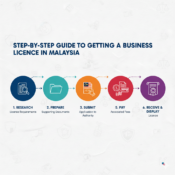
For a broader walkthrough, see our step-by-step guide to getting a business licence in Malaysia.
How Much Does a Trading License Cost in Malaysia?
There is no single national fee. Each council sets its own fee schedule, and the amount depends on the type of business, the size of the premises and the council area.
Expect separate fees for the business licence, any signboard licence and any technical clearances. Ask your council for its current schedule, or speak to us for an estimate based on your location and business type.
How Long Is a Trading License Valid?
Most council licences are issued for one year and must be renewed before they expire.
Some councils now offer longer terms. From 1 July 2026, DBKL allows business licences to be renewed for up to three years, with a 5% discount on two-year renewals and a 10% discount on three-year renewals. To qualify, the licensee must have no outstanding compounds or rental arrears with DBKL.
Do Foreign-Owned Companies Need a WRT Licence?
Yes, if the company is majority foreign-owned and operates in distributive trade. That covers wholesale, retail, import and export, F&B and franchising.
Under KPDN’s Guidelines on Foreign Participation in the Distributive Trade Services, the key requirements include:
- Local incorporation as a Malaysian company under the Companies Act 2016
- Minimum paid-up capital of RM1 million for general distributive trade, with much higher amounts for formats such as departmental stores, superstores and hypermarkets
- KPDN approval before operations start
- An impact study for outlets above 5,000 square feet
- Restricted formats, such as convenience stores, textile shops and petrol stations, are generally closed to foreign-owned operators
In January 2026, KPDN said it was reviewing the 2020 guidelines, particularly for foreign F&B brands. No new figures had been announced at the time of writing, so check the latest position before you apply.
If you are a foreign founder, the WRT approval often affects other steps too, including your Employment Pass application. Our incorporation service for foreigners covers how these pieces fit together.
What Happens If You Trade Without a License?
Local councils can take enforcement action under their by-laws made under the Local Government Act 1976. Depending on the council and the offence, this can include:
- Compound fines
- Seizure of goods and equipment
- Sealing or closure of the premises
- Prosecution in court
Licences are also personal to the licence holder. Councils such as Iskandar Puteri City Council have warned that renting out or transferring a business licence to a third party without written permission can lead to cancellation and legal action.
Common Mistakes SMEs Make
- Signing the lease before checking the zoning. If the premises cannot be licensed for your activity, you are stuck with rent and no permission to trade.
- Assuming the SSM certificate is enough. It is not a licence to operate.
- Mismatched business activity. Registering one MSIC code with SSM and running a different business at the premises can cause delays or rejection.
- Letting the licence lapse. Trading on an expired licence carries the same risk as having none, and outstanding compounds can block renewal discounts.
- Starting operations before KPDN approval (for foreign-owned trading companies).
- “Borrowing” someone else’s licence. This is not allowed and can lead to the licence being cancelled.
A regular compliance audit is a simple way to catch expired licences and mismatched records before an enforcement officer does.
How iComSec Can Help
Getting the order right is what saves time and money: correct SSM registration first, the right premises, then the licence application. iComSec helps SME owners and foreign founders with:
- Sdn Bhd incorporation with business activities set up correctly from day one
- Guidance on local council licensing requirements for your business type and location
- Coordination for foreign-owned companies that need KPDN distributive trade approval
- Ongoing company secretarial support so your records stay consistent with your licences
Frequently Asked Questions
Do I need a trading license if I run my business from home?
It depends on your council and your activity. Some councils allow certain home-based businesses with a licence or permit, while others do not permit commercial activity in residential areas. Check with your local council before you start.
Can I apply for a trading license before registering with SSM?
Generally no. Councils usually require your SSM registration documents as part of the application, so register your business first.
How long does it take to get a trading license in Malaysia?
It varies by council and business type. Low-risk activities with complete documents can be approved quickly, while applications needing fire, health or planning clearances take longer.
What is the minimum capital for a WRT licence?
For a majority foreign-owned company in general distributive trade, the commonly applied minimum is RM1 million paid-up capital. Larger retail formats such as departmental stores and hypermarkets require significantly more.
Is a trading license transferable to a new owner or location?
Usually not. A licence is tied to the licence holder and the premises. Moving premises or changing ownership generally requires a new application or council approval.
Conclusion: Register, Then Get Licensed to Trade
A trading license in Malaysia is what turns a registered company into a business that can legally operate from its premises. For most SMEs, that means a licence from the local council. For foreign-owned trading companies, it also means KPDN approval and meeting the RM1 million capital requirement.
The businesses that avoid delays are the ones that plan the steps in the right order, before signing a lease or ordering stock.
Planning to open a shop, office or trading company? Contact iComSec to get your incorporation and licensing roadmap right from the start.
Related Reading
Trading License Malaysia: Do You Need One and How to Apply (2026 Guide)