
LHDN e-Invoice Compliance Review Framework (2025) – What Malaysian Businesses Must Know
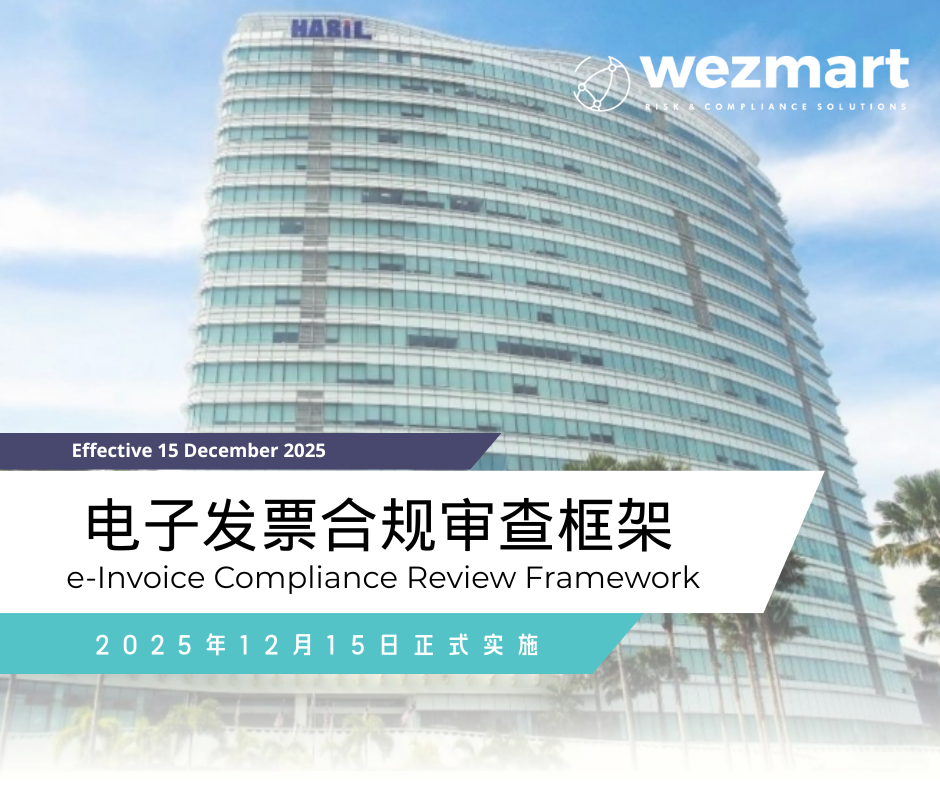
The implementation of e-Invoice (e-Invois) in Malaysia marks a major shift in how tax compliance is monitored and enforced. With effect from 15 December 2025, the Inland Revenue Board of Malaysia (LHDN) has officially enforced the e-Invoice Compliance Review Framework, setting out how compliance reviews will be conducted under the MyInvois system.
For Malaysian companies, directors, and business owners, this framework is more than a technical guideline, it directly impacts tax compliance, record-keeping, and corporate governance.
What Is the e-Invoice Compliance Review Framework?
The e-Invoice Compliance Review Framework (Rangka Kerja Semakan Pematuhan e-Invois) is an official document issued by LHDN that outlines:
The scope and objectives of e-Invoice compliance reviews
The review process and methods
Rights and responsibilities of taxpayers
Applicable offences, penalties, and enforcement actions
The availability of voluntary disclosure
The framework applies to taxpayers implementing e-Invoice under the Income Tax Act 1967, Petroleum (Income Tax) Act 1967, and Labuan Business Activity Tax Act 1990.
Who Is Affected by the e-Invoice Compliance Review?
The framework applies to all businesses that have implemented e-Invoice, including transactions involving:
B2B (Business-to-Business)
B2C (Business-to-Consumer)
B2G (Business-to-Government)
This means SMEs, large companies, foreign-owned entities, and Labuan businesses using e-Invoice may all be subject to compliance reviews.
How Does LHDN Select Cases for Review?
According to the framework, case selection is risk-based, not random.
LHDN may select cases based on:
Computerised system analysis
Risk assessment criteria
Information received from various sources
Indicators of abnormal or inconsistent records
Businesses may be reviewed at any time within the permitted period.
Scope of an e-Invoice Compliance Review
LHDN conducts e-Invoice compliance reviews using a comprehensive review approach.
During a review, LHDN officers may examine:
Sales and purchase e-Invoices
Self-billed and consolidated e-Invoices
Debit notes, credit notes, and refund records
Accounting records and financial statements
Bank statements
Electronic systems, servers, and accounting software
If business records are incomplete, LHDN may also examine non-business records, such as bank statements, subject to legal provisions.
How Far Back Can LHDN Review?
The framework provides that:
Compliance reviews may cover up to two (2) Years of Assessment
Enforcement actions may be taken within the time limits allowed under the relevant tax laws
This highlights the importance of proper record retention and system consistency.
Taxpayer Responsibilities During a Compliance Review
Under the framework, taxpayers are required to:
Cooperate with LHDN officers
Provide complete and accurate documents
Allow access to records and electronic systems
Maintain proper records in accordance with LHDN guidelines
Failure to cooperate or provide records may constitute an offence under existing tax laws.
Penalties for e-Invoice Non-Compliance
Non-compliance with e-Invoice requirements may result in penalties under existing legislation, including:
Fines ranging from RM200 to RM20,000 per offence
Possible prosecution, depending on the nature and severity of the offence
Penalties apply to failures such as not issuing e-Invoices, incorrect reporting, or failing to maintain proper records.
Voluntary Disclosure: Is There a Way to Reduce Risk?
Yes.
The framework allows taxpayers to make voluntary disclosures before a compliance review begins.
However:
Disclosures must be complete and supported by documentation
Incomplete disclosures may be rejected
LHDN retains discretion to proceed with a formal review if necessary
Early action can significantly reduce compliance risk.
Business Implications for Directors and Management
The e-Invoice Compliance Review Framework makes it clear that e-Invoice compliance is no longer purely an accounting function.
From a business perspective, it affects:
Corporate governance
Tax risk management
Internal controls and systems
Management accountability
Directors and business owners should ensure that:
e-Invoice systems comply with LHDN requirements
Accounting records and e-Invoice data are consistent
Internal processes support compliance reviews
Records are complete and readily available
How Businesses Should Prepare Now
To reduce risk, businesses should:
Conduct an internal e-Invoice compliance review
Verify consistency between accounting systems and e-Invoice data
Ensure proper record-keeping procedures are in place
Seek professional guidance where gaps are identified
Early preparation is always more cost-effective than reactive compliance.
Conclusion
The LHDN e-Invoice Compliance Review Framework signals a more structured and transparent approach to tax enforcement in Malaysia’s digital economy.
Businesses that treat e-Invoice compliance as a management and governance priority, rather than a technical requirement, will be better positioned to manage risk and avoid penalties.
Need Help with e-Invoice Compliance?
If you are unsure whether your business is fully prepared for an e-Invoice compliance review, professional assistance can help you assess risks, review systems, and improve readiness.
👉 Contact us for professional assistance.
⚠️ Disclaimer:
This article is for general information purposes only and does not constitute tax or legal advice. Please refer to the latest official guidelines and publications issued by LHDN for authoritative information.
📄 The official framework is available on the LHDN (HASiL) website.
https://www.hasil.gov.my/media/vemjfro3/20251215_rangka-kerja-semakan-pematuhan-e-invois.pdf
LHDN e-Invoice Compliance Review Framework (2025) – What Malaysian Businesses Must Know