Beneficial Ownership Reporting: What Happens If You Don’t Update BOI Information
Most Sdn Bhd owners in Malaysia know, at least in theory, that they need to submit Beneficial Ownership Information (BOI) to SSM. What far fewer people understand is that this isn’t a one-time filing you can tick off and forget. Beneficial ownership reporting is an ongoing obligation, and every time your company’s real owners or controllers change, you have a narrow window to update it.
Miss that window, and the consequences aren’t gentle reminders. They’re statutory offences with fines that scale the longer you leave it unresolved, and in serious cases, personal liability that reaches beyond the company itself.
If you’re unclear on what beneficial ownership actually means or who counts as a beneficial owner in the first place, our guide on beneficial ownership reporting in Malaysia covers the fundamentals. This article focuses specifically on what happens when that information isn’t kept current, and what to do if you’re already behind.
A Quick Recap: What Counts as Beneficial Ownership
A beneficial owner is the individual who actually owns or controls a company, as opposed to whoever’s name appears on the shareholder register. Under SSM’s guidelines, this generally means someone with more than 25% ownership, voting rights, or the ability to appoint or remove the majority of directors. In straightforward company structures, the beneficial owner and the registered shareholder are the same person. In more complex structures, including nominee arrangements, they can be different individuals entirely.
Every company incorporated under the Companies Act 2016 has to identify, record, and report this information, regardless of size or industry. There are no exemptions.
When You’re Required to Update BOI
This is the part that trips up most companies. Beneficial ownership isn’t a “set it and forget it” filing. You’re required to update your BOI whenever the underlying facts change, and the update window is short.
Situations that trigger an update obligation include:
- A change in who owns or controls the company, such as a new majority shareholder
- A shareholder acquiring beneficial owner status they didn’t previously hold
- A change in the identity or particulars of an existing beneficial owner
- Restructuring that shifts control, even if the registered shareholders on paper stay the same
Under the framework, a person who becomes a beneficial owner must notify the company within 30 days of acquiring that status, and any changes must be reported promptly. Once the company has the updated information, it generally needs to be lodged through the Electronic Beneficial Ownership System (e-BOS) within 14 days. That’s a tight window, and it’s easy to miss if nobody in the company is actively tracking ownership changes.
For newly incorporated companies, there’s a separate deadline tied to your first company secretary appointment. Our guide to how to appoint a company secretary in Malaysia explains that process, which matters here because your BOI obligations effectively start running from that point.
What Happens If You Don’t Update BOI Information
Fines That Escalate the Longer You Wait
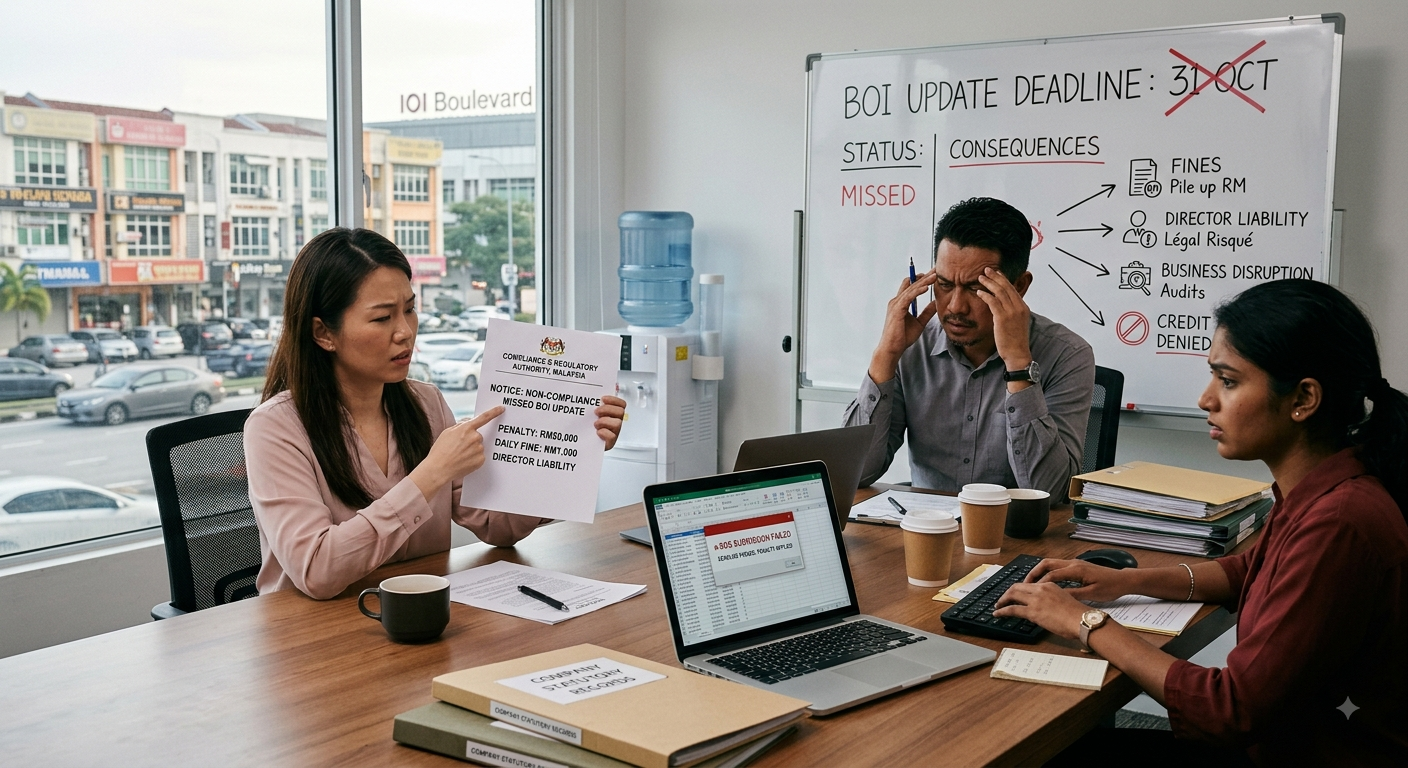
Failure to maintain or update your beneficial ownership register is a statutory offence. Companies that don’t comply can face fines of up to RM20,000, plus a continuing daily penalty of up to RM500 for every day the breach continues. This isn’t a one-off slap on the wrist. The longer the information stays outdated, the more expensive it gets.
For Limited Liability Partnerships, the same principle applies under a separate provision in the LLP Act 2012, with continuing non-compliance attracting an additional RM500 per day, and in some enforcement guidance, figures as high as RM1,000 per day for LLPs that ignore the requirement entirely.
Failing to Notify or Issue Required Notices
Separately from the register itself, there are obligations around issuing notices to identify beneficial owners in the first place. Failing to do this properly can carry a fine of up to RM50,000, or imprisonment of up to three years. This applies to the company’s obligation to actively seek out and confirm who its beneficial owners are, not just to record what’s already known.
False or Misleading Submissions Are Treated Far More Seriously
Where inaccurate or misleading beneficial ownership information is knowingly submitted, the penalties move into a different category entirely. These offences can carry fines running into the millions of ringgit, alongside potential lengthy imprisonment. This tier of penalty exists specifically to deter companies and individuals from using inaccurate filings to obscure who’s really behind a company, which ties closely into why loosely structured nominee arrangements carry real legal risk of their own.
Beneficial Owners Themselves Can Be Penalised
It isn’t only the company that carries exposure. An individual who qualifies as a beneficial owner but fails to disclose their status, or fails to notify the company of a change, can be personally penalised under the framework’s own provisions. This is a point many shareholders miss. The obligation doesn’t sit solely with the company secretary or the board. It sits with the beneficial owner too.
Why This Gets Missed So Often
In practice, BOI updates fall through the cracks for a few predictable reasons:
- Ownership changes happen informally first. A share transfer or new investor comes in, everyone shakes hands and moves on, and nobody circles back to update the statutory filing.
- It’s assumed the annual return covers it. It doesn’t. Beneficial ownership must be submitted through e-BOS specifically, even if the same information was already reflected in your annual return. The two filings serve different purposes and aren’t interchangeable.
- Nobody owns the responsibility internally. Without a company secretary actively monitoring ownership changes, a 14-day window is easy to blow past before anyone notices.
How to Fix It If You’re Already Behind
If you’ve realised your BOI is out of date, the priority is to correct it as quickly as possible rather than waiting for SSM to flag it. Continuing daily penalties mean every extra day of delay adds to the eventual cost. Practical steps include:
- Confirm exactly who your current beneficial owners are, including anyone whose status may have changed but was never formally recorded
- Gather the required identification and ownership documentation for each beneficial owner
- Lodge the updated information through e-BOS via the SSM4U portal without delay
- Review your internal process so the next ownership change doesn’t slip through unnoticed
This is exactly the kind of ongoing compliance task that benefits from having a licensed company secretary actively involved rather than reactive. A properly engaged cosec identifies beneficial owners, maintains the register, and lodges updates through the correct channel on your behalf, the same way they track your other statutory deadlines, covered in our guide to company secretary duties in Malaysia.
Frequently Asked Questions
How long do I have to update BOI after an ownership change? A person who becomes a beneficial owner should notify the company within 30 days of acquiring that status. Once the company has the updated information, it generally needs to be lodged through e-BOS within 14 days.
What’s the maximum fine for failing to update beneficial ownership information? Failure to maintain or update the beneficial ownership register can carry a fine of up to RM20,000, plus a continuing daily penalty of up to RM500 for as long as the breach continues.
Does filing my annual return also update my BOI? No. Beneficial ownership information must be submitted separately through e-BOS, even if the same details already appear in your annual return. They are treated as distinct filings under different provisions.
Can a beneficial owner be personally penalised, not just the company? Yes. An individual who qualifies as a beneficial owner but fails to disclose their status or notify the company of a change can be personally penalised, separately from any penalty the company itself faces.
What happens if I submit false beneficial ownership information? Knowingly submitting false or misleading beneficial ownership information is treated far more seriously than a late update, with penalties that can run into millions of ringgit and lengthy imprisonment.
Who is responsible for keeping BOI up to date, the company or the company secretary? The statutory obligation sits with the company, its officers, and its beneficial owners, but in practice, a licensed company secretary is the appropriate party to manage identification, record-keeping, and lodgement on the company’s behalf.
Conclusion
Beneficial ownership reporting doesn’t end once you’ve made your first submission. It’s a living obligation that follows every change in who really owns or controls your company, with a tight 14-day window and penalties that get more expensive the longer they’re ignored. The good news is this is entirely avoidable with the right process in place.
iComSec’s company secretary services in Malaysia include ongoing beneficial ownership monitoring, so ownership changes get captured and lodged before they become a compliance problem. If you’re not sure whether your BOI is current, or you know it isn’t, contact our team and we’ll help you get it corrected quickly.
BOI Update Malaysia: What Happens If You Miss It

Recent Posts