SSM’s Corporate Registry System (CRS): What Changed and What Every Sdn Bhd Needs to Know
If your company secretary has seemed unusually quiet lately, or an incorporation or filing took longer than you expected, there’s a good chance it’s connected to the biggest change to Malaysia’s company registry system in years. SSM has rolled out the Corporate Registry System, known as CRS, replacing the platforms most Malaysian companies had relied on for statutory filings for the better part of a decade.
This wasn’t a minor software update. MyCoID, e-Secretary, and several related legacy systems have been switched off entirely, with CRS now the only channel for company incorporation, statutory lodgements, and company information updates. The transition came with real disruption, and it introduced at least one deadline that most SME owners won’t know exists unless someone points it out.
This article explains what CRS actually is, what changed during the rollout, what’s different for you day to day, and the specific compliance deadline buried in the transition that’s worth checking against your own company’s structure.
What Is the Corporate Registry System (CRS)?
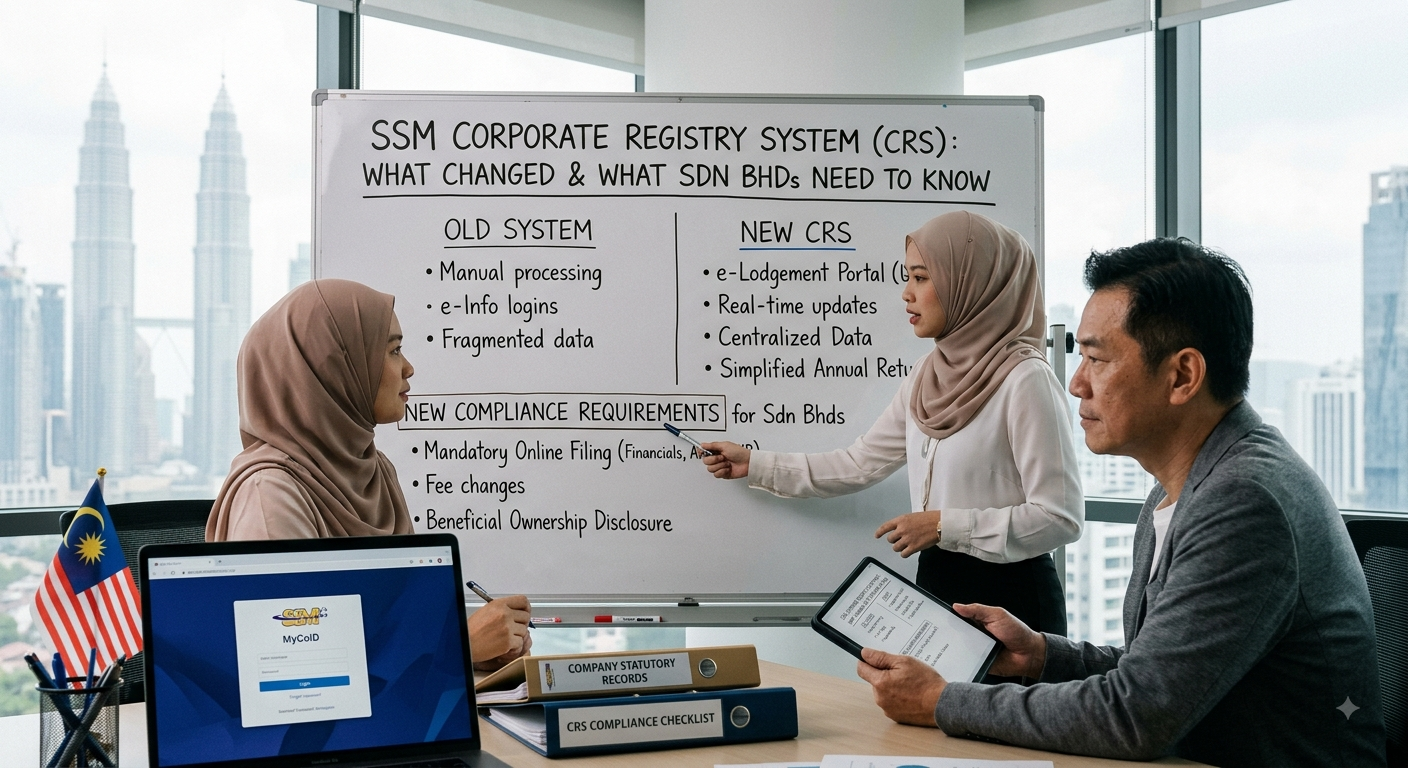
CRS is SSM’s new digital platform for company incorporation, updating company information, and lodging statutory documents under the Companies Act 2016, alongside related legislation covering interest schemes and trust companies. It was introduced as part of SSM’s broader digital transformation agenda, built to replace a patchwork of legacy systems, including MyCoID 2016, e-Secretary, MBRS, e-BOS, MyLLP, and EzBiz, with a single unified platform.
In practical terms, this is the system your company secretary now uses for the same tasks they always handled on your behalf: incorporating companies, filing your annual return, lodging changes to directors or shareholders, and submitting other statutory documents.
How the Rollout Actually Went
The transition to CRS wasn’t a simple overnight switch, and if your filings were affected during this period, it’s worth understanding why.
SSM initially set a go-live target of 30 June 2026, with a defined cutover schedule closing access to the legacy systems in stages beforehand. Online services and legacy platforms, including MBRS, e-BOS, MyLLP, e-Secretary, and EzBiz, were progressively taken offline in the lead-up, with no new submissions accepted until the new system was ready.
The rollout then extended beyond the original date, with a further system closure in early July before CRS was confirmed as fully live in the middle of the month. Once restored, SSM also announced something worth planning around permanently: a scheduled daily maintenance window during which the CRS portal is expected to be unavailable. If your company secretary or internal team handles time-sensitive filings, it’s worth building this daily downtime into your own submission planning, particularly as a deadline approaches.
If your company had pending filings that fell within any part of this transition window, the right first step is to confirm the status directly with your company secretary, since outstanding submissions were generally queued and processed once the system came back online, rather than lost.
What’s Different for Your Company Now
For most day-to-day purposes, CRS handles the same functions the old systems did, just through a different interface. A few practical changes are worth knowing about:
- Access is through the SSM4U portal. Existing SSM4U account credentials continue to work, so there’s no separate registration needed to reach CRS.
- Express Filing is no longer available. Companies that previously relied on expedited processing through the legacy systems should plan for standard processing timelines going forward.
- Lodgement fees remain unchanged. The cutover didn’t come with a fee restructure, so budgeting for statutory filings continues as before.
- Payments aren’t refunded on withdrawn applications. This was already the practice under the legacy systems, but it’s worth reconfirming with whoever is managing your filings, since the underlying rule carried over.
These aren’t dramatic changes on their own, but they do mean expecting the exact same workflow as before could catch you out, particularly around timing.
The Deadline Most SME Owners Don’t Know About
Alongside the CRS launch, SSM issued a separate practice directive concerning the lodgement of shareholders’ and share capital information. This matters specifically for companies with more than one class of shares, or with foreign share registration. If your company has a single class of ordinary shares and no foreign registration involved, this particular requirement generally doesn’t apply to you.
For companies it does apply to, current member and capital structure data needs to be formally lodged, covering capital structure and shareholder details, before certain share and capital transactions can be processed through CRS. This is separate from your routine annual return filing and needs to be handled specifically to unlock those transaction types in the new system.
If your company has a more complex share structure, whether from multiple share classes, past corporate exercises, or foreign shareholders, it’s worth checking with your company secretary now, rather than discovering the requirement only when you next try to process a share-related transaction and find it blocked.
What This Means for Beneficial Ownership and Other Filings
Since e-BOS was one of the systems folded into this transition, it’s a good moment to double-check that your company’s beneficial ownership information is still accurately reflected post-migration, particularly if you had a submission in progress around the cutover dates. The same applies to any MBRS-related filings that may have been mid-process when the legacy systems were taken offline.
What You Should Do Now
- Confirm with your company secretary whether any of your company’s filings were affected by the transition window, and whether anything is still queued
- If your company has multiple share classes or foreign shareholders, ask specifically whether the shareholder and capital structure lodgement requirement applies to you
- Build the new daily maintenance window into your own planning if you or your team ever submit filings directly, rather than only through a company secretary
- Treat this as a good prompt to do a general compliance check, confirming your annual return, beneficial ownership records, and company particulars are all currently accurate on the new system
Frequently Asked Questions
What happened to MyCoID and e-Secretary? Both were retired and fully replaced by SSM’s new Corporate Registry System. Filings and services that used to run through MyCoID and e-Secretary are now handled entirely through CRS.
Do I need a new login to access CRS? No. CRS is accessed through the existing SSM4U portal, and current SSM4U account credentials continue to work without needing separate registration.
Are SSM’s filing fees different under CRS? No. Current lodgement fees remained the same through the transition to CRS.
Is Express Filing still available under CRS? No. The expedited Express Filing option available under the legacy systems is not currently offered through CRS.
My company has multiple share classes. Do I need to do anything specific? Possibly. SSM introduced a separate requirement for companies with more than one class of shares, or with foreign share registration, to lodge current shareholder and capital structure information before certain transactions can be processed in CRS. It’s worth checking this directly with your company secretary if this applies to your company’s structure.
What should I do if my filing was affected by the system downtime during the transition? Confirm the status with your company secretary. Submissions that were pending during the transition window were generally queued and processed once CRS came fully online, rather than lost.
Conclusion
The move to CRS is the most significant change to Malaysia’s corporate registry infrastructure in years, and while most of it affects the systems behind the scenes rather than your company’s actual obligations, there are real details worth checking, particularly the shareholder and capital structure lodgement requirement if your company has a more complex share structure.
If you’re not sure whether your company’s filings came through the transition cleanly, or whether the new requirements apply to you, iComSec’s company secretary services in Malaysia can check your company’s current status on CRS and make sure nothing was missed. Contact our team for a quick compliance check.
SSM’s Corporate Registry System (CRS): What Changed and What Every Sdn Bhd Needs to Know

Recent Posts