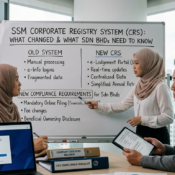


MBRS Filing Service Malaysia: What It Covers and Why Most Sdn Bhd Owners Outsource It
If you’ve registered a Sdn Bhd in Malaysia, you’ve probably already heard the term MBRS thrown around by your company secretary, usually attached to a deadline. But what actually is it, why does it involve a format called XBRL that sounds more technical than anything else in your compliance calendar, and why do so many business owners simply hand this off to a filing service instead of doing it themselves?
This guide explains what MBRS filing actually covers, what SSM requires, what happens if you miss it, and why an MBRS filing service in Malaysia is one of the most commonly outsourced compliance tasks for Sdn Bhd owners, even those who handle everything else in-house.
What Is MBRS, in Plain Terms?
MBRS stands for the Malaysian Business Reporting System, SSM’s digital platform for filing Annual Returns, Financial Statements, and exemption applications. Instead of lodging printed documents over the counter, companies submit these filings electronically in a structured data format called XBRL, eXtensible Business Reporting Language, a global open standard for machine-readable business data used by regulators in more than 50 countries.
In practice, MBRS filing covers three main submission types:
- Annual Return (AR): a snapshot of your company’s structure, including registered office address, director and shareholder details, share capital, and company secretary particulars.
- Financial Statements (FS): your company’s audited or unaudited financial statements, converted into the XBRL taxonomy format SSM requires.
- Exemption Applications (EA): applicable where your company qualifies for certain filing exemptions, such as an audit exemption for smaller companies.
SSM introduced MBRS in 2018, and it became mandatory nationwide for Annual Returns and unaudited financial statements from March 2019. In late 2024, SSM rolled out MBRS 2.0, an updated version built on the latest Malaysian Financial Reporting Standard (MFRS) and Malaysian Private Entity Reporting Standard (MPERS), which also extended mandatory filing to previously exempted banking, financing, and insurance entities regulated by Bank Negara Malaysia.
Who Needs to File, and When
Nearly every company registered in Malaysia falls under MBRS obligations, private companies, public companies, foreign companies registered locally, and Exempt Private Companies (EPCs) alike. Dormant companies are not exempt either; they still need to file annual returns even with no active operations.
Key deadline to know: under Section 68 of the Companies Act 2016, companies must lodge their Annual Return within 30 days of their incorporation anniversary date each year. Financial statements have their own separate timeline tied to your financial year end.
Important detail many owners miss: the responsibility to file on time sits with the company’s officers, meaning directors, even when the actual preparation work is delegated to a company secretary or an outsourced filing service.
What Happens If You File Late (or Not at All)
This is where MBRS moves from “administrative task” to genuine business risk:
- Statutory fines up to RM50,000 may be imposed on the company and every officer in default under Section 68(9) of the Companies Act 2016, with additional daily default fines possible for continuing non-compliance.
- Company strike-off risk applies where a company fails to lodge Annual Returns for three or more consecutive years, giving the Registrar grounds to initiate strike-off proceedings.
- Reputational and banking friction. Late or inconsistent SSM filings can complicate bank account renewals, licence applications, and due diligence checks from potential business partners or investors, since your SSM Business Profile is one of the first things counterparties check.
Common mistake: Assuming a late annual return is a minor administrative slip. The financial and legal exposure sits with directors personally, not just the company, which is exactly why timely filing shouldn’t be left to chance.
Why the XBRL Format Trips Up First-Time Filers
Even business owners who are comfortable with paperwork often get stuck at the technical step. SSM’s official preparation tool, mTool, is an Excel-based application used to convert your Annual Return or Financial Statement data into the XBRL taxonomy format before submission through mPortal.
Common issues at this stage include:
- Anniversary date mismatches. The most frequent rejection happens when the anniversary date entered doesn’t match the incorporation date on record, so this should always be verified against your Certificate of Incorporation before validation.
- Incomplete shareholding or director data. Missing NRICs or inconsistent shareholding structures get flagged during validation and must be corrected before a “Clean” status is achieved.
- Version and taxonomy errors. SSM periodically updates the mTool version and underlying MBRS taxonomy, and filings prepared on an outdated version can fail validation.
- File handling mistakes. The XBRL instance document generated by the system should never be renamed or manually edited, since the upload process depends on specific system-generated naming conventions.
- Digital certificate issues. A valid Digital Certificate (PKI) is required to complete submission, and certificate setup or renewal problems are a common last-minute holdup.
None of these are conceptually difficult on their own, but together they explain why so many directors, especially those juggling this alongside actually running the business, prefer to hand the entire process to someone who does it routinely.
Why Most Sdn Bhd Owners Use an MBRS Filing Service Instead
This is where a company secretary or dedicated filing service earns its fee. A proper MBRS filing service typically handles:
- Deadline tracking, so your Annual Return and Financial Statement filings are flagged well ahead of the 30-day window, not discovered at the last minute.
- Mapping your financial data to the correct MBRS taxonomy, translating your profit and loss statement and balance sheet into the XBRL tags SSM’s system expects.
- Validation and error resolution, catching mismatched dates, incomplete director or shareholder data, and taxonomy errors before submission, rather than after a rejection.
- Digital certificate and portal management, since the mPortal submission process and PKI certificate requirements are easier to manage for a provider handling many filings than for a director doing this once a year.
- Director sign-off coordination, preparing the declaration and annual return for your review and signature, so your involvement is limited to reviewing and approving rather than doing the technical preparation yourself.
For most SME owners, the actual cost of an MBRS filing service is small relative to the statutory fines and strike-off risk of getting it wrong, and it frees up time that’s better spent running the business rather than learning XBRL taxonomies.
What to Look for in an MBRS Filing Service
- Proactive deadline reminders, not just reactive filing once you’ve already reached out.
- Clear communication on what they need from you, and by when, so you’re not scrambling to gather director or shareholder details at the last moment.
- A track record with the current MBRS 2.0 taxonomy, since filings prepared on outdated versions can fail validation.
- Transparent pricing, ideally bundled with your broader company secretarial service so you’re not paying separately for something that’s really part of routine compliance.
- A named point of contact who can explain what’s being filed and why, rather than a black-box process you’re simply asked to sign off on.
Frequently Asked Questions
1. Is MBRS filing mandatory for all companies in Malaysia? Yes, nearly all companies registered in Malaysia, including private companies, public companies, and foreign companies registered locally, must file through MBRS. Dormant companies must still file annual returns.
2. What’s the deadline for filing an Annual Return through MBRS? Companies must lodge their Annual Return within 30 days of their incorporation anniversary date each year, under Section 68 of the Companies Act 2016.
3. What happens if my company misses the MBRS filing deadline? Statutory fines of up to RM50,000 may apply to the company and every officer in default, with additional daily fines possible, and companies that fail to file for three or more consecutive years risk being struck off the register.
4. Can my company secretary handle MBRS filing for me? Yes, this is one of the core services most company secretaries and corporate filing providers offer, since directors remain personally responsible for timely lodgement even when preparation is delegated.
5. Does a dormant company still need to file through MBRS? Yes. Dormant status doesn’t exempt a company from filing its Annual Return.
Conclusion: Don’t Let a Technical Filing Become a Legal Risk
MBRS filing is a routine, recurring obligation, but the consequences of getting it wrong, statutory fines, personal liability for directors, and eventual strike-off risk, are anything but routine. Between the XBRL format, taxonomy updates, and strict deadline windows, it’s easy to see why most Sdn Bhd owners choose to have this handled by a dedicated filing service rather than managing it themselves once a year.
If you want your Annual Return and Financial Statement filings handled accurately and on time, every year, without the last-minute scramble, iComSec’s MBRS filing service takes care of the preparation, validation, and submission so you can focus on running your business.
Talk to iComSec today for a consultation on MBRS filing and ongoing SSM compliance.
Related reading: Sdn Bhd Requirements in Malaysia | First Year Compliance Calendar | Company Secretary Services
MBRS Filing Service Malaysia: What It Covers and Why Most Sdn Bhd Owners Outsource It

Recent Posts