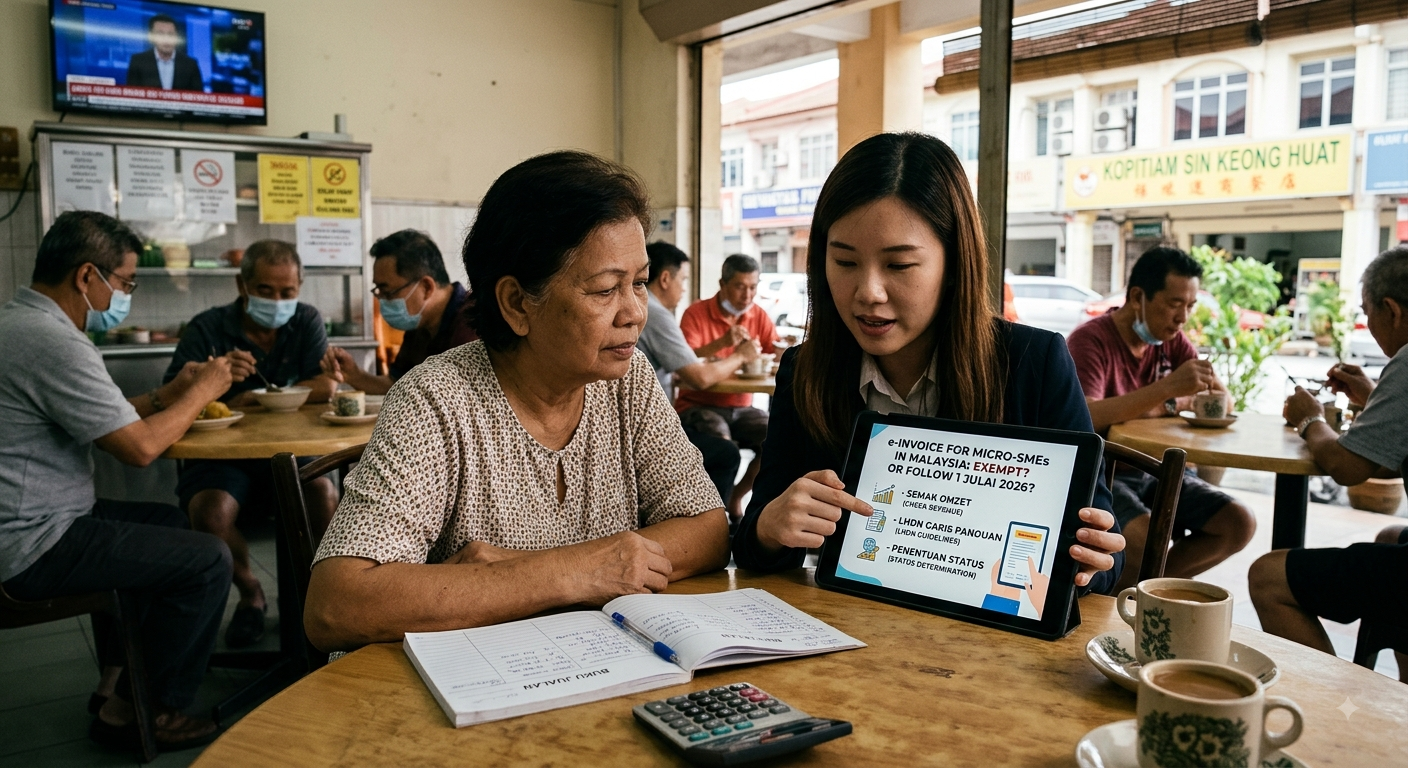
e-Invoice for Micro-SMEs in Malaysia: Are You Exempt, or Does the 1 July 2026 Date Still Apply to You?
If you run a small business in Malaysia and you’ve heard that a new e-Invoice deadline is coming for micro-SMEs on 1 July 2026, the honest answer is more nuanced than most summaries make it sound. The short version often repeated online, that every business under RM1 million in turnover faces a “Phase 5” rollout in July 2026, isn’t accurate anymore. The government scrapped that plan entirely and replaced it with something more generous for most small businesses, but with a real trap for a specific group that easily gets overlooked.
This article explains exactly where things stand, based on LHDN’s own current guidance, so you can work out with confidence whether your business is fully exempt or whether that 1 July 2026 date genuinely applies to you.
What Actually Happened to “Phase 5”
Malaysia’s e-Invoice mandate rolled out in phases by annual turnover, starting with the largest taxpayers in August 2024 and working down through progressively smaller businesses. The original plan included a final phase for businesses with turnover below RM500,000, initially scheduled for mid-2026.
That plan changed. The government raised the exemption threshold from RM500,000 to RM1 million, effective 1 January 2026, and in doing so, cancelled the originally planned final phase altogether. In its place, LHDN now applies a straightforward rule: taxpayers with annual turnover or revenue below RM1 million are exempt from issuing e-Invoices entirely, not subject to a future compliance date.
If your business is small, independently owned, and has no complicated shareholding structure, this is genuinely good news. You are very likely fully exempt, not counting down to a July deadline.
Where the 1 July 2026 Date Actually Comes From
Here’s the part that gets lost in most summaries. The exemption isn’t automatic for every business under RM1 million. LHDN’s own guidance sets out specific criteria a business must meet to qualify, and businesses that fail those criteria, despite having turnover below RM1 million, are required to implement e-Invoice starting from 1 July 2026, referred to as the concessionary implementation date.
You do not qualify for the exemption, even with turnover under RM1 million, if any of the following apply:
- Your business has a non-individual (corporate) shareholder whose own annual turnover or revenue is RM1 million or more
- Your business is a subsidiary of a holding company with annual turnover or revenue of RM1 million or more
- Your business is treated as a related company to another company with annual turnover or revenue of RM1 million or more
That third category is where a lot of small business owners get caught out, so it’s worth understanding exactly how “related company” is defined for this purpose.
What Counts as a “Related Company” (And What Doesn’t)
LHDN’s rules focus specifically on corporate shareholding and control, not on individuals wearing multiple hats.
These situations do create a related company relationship, potentially pulling an otherwise-exempt small business into the 1 July 2026 date:
- A corporate shareholder holding at least 20% of your company’s issued share capital, if that corporate shareholder itself has turnover reaching RM1 million
- A corporate shareholder holding less than 20%, but who has agreed control over your company’s operations
- Being a subsidiary of a larger corporate group
These situations do not create a related company relationship, even though they might seem like they should:
- Two companies owned by the same individual shareholder are not treated as related for this purpose, even if that person owns 100% of both
- Two companies sharing a common director who holds no shares in either company are not treated as related, regardless of how involved that director is in running both businesses
- A common individual shareholder who also serves as a common director still doesn’t create a related company relationship, since the assessment is based on corporate shareholding and control, not individual involvement
In practice, this means a solo entrepreneur running two or three small companies under their own name generally keeps each company’s exemption intact, provided there’s no corporate entity in the ownership chain. But the moment a holding company, investment vehicle, or larger corporate group sits above or beside your business in the ownership structure, it’s worth checking your position carefully rather than assuming you’re automatically exempt.
How to Work Out Which Category You’re In
- Check your shareholders. If every shareholder is an individual person, and none of them jointly control another company that has significant turnover, you’re on solid ground for the exemption.
- Check whether you’re part of a group. If your company is a subsidiary, or sits alongside sibling companies under a shared corporate parent, look at whether that parent or any related entity has turnover reaching RM1 million.
- Don’t assume a shared director is a problem on its own. A director with no shareholding doesn’t trigger related company status by themselves.
- Remember the rule is permanent once triggered. If your business is assigned a mandatory implementation date, whether through crossing RM1 million in turnover or failing the exemption criteria, that obligation continues even if your turnover later drops back below the threshold. There’s no reverting to exempt status once you’re in scope.
- Sole proprietors should add up all their businesses. If you run more than one sole proprietorship, LHDN aggregates the turnover across all of them when testing against the RM1 million threshold.
If any of this feels uncertain for your specific structure, this is exactly the kind of question worth raising with your company secretary or tax adviser rather than guessing, given how permanent the consequence is once a mandatory date is assigned.
What Compliance Actually Involves From 1 July 2026
For businesses that don’t qualify for the exemption, the 1 July 2026 date brings the same core obligations that larger businesses have already been through: issuing validated e-Invoices through LHDN’s MyInvois system for relevant transactions, in the required digital format. Our earlier coverage of the Phase 4 rollout and the transactions that can no longer be consolidated walks through what this looks like in practice for businesses already in scope.
LHDN provides the MyInvois Portal and mobile app free of charge, and there’s no requirement to purchase expensive new systems just to comply, though many growing businesses choose to integrate e-Invoice issuance directly into their existing accounting software for convenience.
What Happens If You Don’t Comply
Failure to issue an e-Invoice when required is a statutory offence under the Income Tax Act 1967, carrying a fine of between RM200 and RM20,000, imprisonment of up to six months, or both, for each instance of non-compliance. This applies once your business is genuinely in scope, whether that’s because your turnover has grown past RM1 million or because your exemption never applied in the first place due to your shareholding structure.
A Penalty-Free Window to Fix Past Gaps: The e-Invoice SVDP
If your business has already passed its mandatory implementation date, whether from an earlier phase or once the 1 July 2026 date applies to you, and you suspect there are gaps in your e-Invoice history, missed submissions, errors, or transactions that were never reported, there’s a genuinely useful development worth knowing about.
On 7 July 2026, LHDN introduced the e-Invoice Special Voluntary Disclosure Programme, known as the SVDP, running until 31 December 2027. It gives businesses a defined window to come forward and correct past e-Invoice non-compliance without facing penalties, enforcement action, or prosecution for the issues disclosed, provided the disclosure is made in good faith and the corrected e-Invoices meet the required specifications.
The SVDP covers businesses that:
- Never submitted e-Invoices for a period after their mandatory implementation date
- Submitted e-Invoices containing errors or information that didn’t meet the required specifications
- Are currently undergoing, or have been notified of, an e-Invoice compliance review by LHDN
This relief doesn’t extend to cases involving fraud, wilful default, or negligence, and corrections made under the programme need to use specific document versions reserved for SVDP disclosures, rather than standard e-Invoice submissions.
For a business newly brought into scope by the 1 July 2026 date, this matters in a practical way. If it takes time to get your systems and processes fully sorted once you realise you don’t qualify for the exemption, the SVDP gives genuine breathing room to identify and fix any early gaps voluntarily, rather than waiting for LHDN to flag them first.
A Small Silver Lining for Genuinely Exempt Businesses
If your business is properly exempt, you’re not required to issue consolidated e-Invoices or self-billed e-Invoices at all. LHDN does encourage exempt businesses to adopt e-Invoice voluntarily, and there’s a tax deduction of up to RM50,000 available for environmental, social, and governance related expenditure, which includes consultation fees for e-Invoice implementation, for micro, small, and medium enterprises through year of assessment 2027. If you sell through a local e-commerce platform, note that the obligation to issue e-Invoices for those specific transactions sits with the platform, not with you, even while your business remains exempt for sales made through your own physical store or channels.
Frequently Asked Questions
Is every business under RM1 million turnover exempt from e-Invoice in Malaysia? Not automatically. Businesses under RM1 million are generally exempt, but the exemption doesn’t apply if your business has a corporate shareholder with turnover reaching RM1 million, is a subsidiary of a larger company, or is otherwise treated as a related company to one that meets the threshold.
What is the 1 July 2026 e-Invoice date for? It’s the concessionary implementation date for businesses whose turnover was below RM1 million but who don’t meet the exemption criteria, typically due to corporate shareholding or group structure, as well as certain businesses that crossed the RM1 million threshold in recent years of assessment.
Does having a business partner who’s also a shareholder in my other company affect my exemption? Only if that co-shareholder is a corporate entity, not an individual. Two companies owned by the same individual person, even with overlapping directors, generally aren’t treated as related companies for e-Invoice purposes.
If my company’s turnover drops back below RM1 million after being mandated, do I become exempt again? No. Once a mandatory e-Invoice implementation date has been assigned, the obligation continues regardless of later fluctuations in turnover.
What’s the penalty for not issuing an e-Invoice when required? Failure to issue a required e-Invoice is an offence under the Income Tax Act 1967, carrying a fine of RM200 to RM20,000, imprisonment of up to six months, or both, for each instance.
What is the e-Invoice SVDP and does it help newly mandated businesses? The e-Invoice Special Voluntary Disclosure Programme, introduced by LHDN on 7 July 2026 and running until 31 December 2027, lets businesses voluntarily correct past e-Invoice non-compliance, missed submissions, errors, or omitted transactions, without facing penalties or enforcement action, provided the disclosure is made in good faith. It’s a useful option for businesses still catching up on their e-Invoice obligations after being newly brought into scope.
Conclusion
The real story on e-Invoice for Malaysian micro-SMEs isn’t a blanket July 2026 deadline. It’s a genuine exemption for most straightforward small businesses, with a specific and easy-to-miss carve-out for businesses tied into a larger corporate structure. Getting this wrong in either direction carries real consequences, either missing a mandatory compliance date or overbuilding systems you don’t yet need.
If you’re not sure which category your business falls into, iComSec’s e-Invoice compliance services can review your shareholding structure against LHDN’s exemption criteria and confirm exactly where you stand. Contact our team before you assume either way.
e-Invoice for Micro-SMEs in Malaysia: Are You Exempt, or Does the 1 July 2026 Date Still Apply to You?

Recent Posts