ESG Reporting for SMEs in Malaysia: Is It Coming for You Next?
If you run a Sdn Bhd that supplies goods or services to a larger Malaysian company, you may have already noticed something new creeping into your client relationships: a request for your carbon emissions data, a supplier sustainability questionnaire, or a clause in a renewed contract asking about your environmental and governance practices.
This isn’t a coincidence, and it isn’t going away. Malaysia’s ESG reporting requirements are currently aimed at listed companies, but they’re built to cascade down supply chains, and SMEs sit directly in that path. You don’t need to be listed on Bursa Malaysia to feel the effects of ESG reporting. You just need to be a supplier, vendor, or partner to a company that is.
This article explains where Malaysia’s ESG reporting framework currently stands, why SMEs are increasingly being pulled into it even without a legal mandate, and what practical steps make sense to prepare now rather than scrambling later.
What ESG Reporting Actually Means
ESG stands for Environmental, Social, and Governance. It refers to a structured way of measuring and disclosing how a company manages its environmental impact, treats its people, and governs itself, covering areas like carbon emissions, labour practices, board composition, and anti-corruption controls.
For governance specifically, this overlaps with things your company already has to get right regardless of ESG, such as maintaining accurate beneficial ownership records and keeping proper statutory documentation through your company secretary. ESG reporting essentially formalises and extends practices that good corporate governance already touches on.
Where Malaysia’s ESG Requirements Currently Stand
Malaysia’s ESG reporting framework is anchored by the National Sustainability Reporting Framework, launched by the Securities Commission Malaysia in September 2024. It sets a phased path toward mandatory, IFRS-aligned sustainability disclosures for listed companies:
- Large-cap issuers above RM2 billion in market capitalisation began mandatory sustainability disclosures under IFRS S1 and S2 standards starting in the 2025 reporting cycle.
- The remaining Main Market issuers on Bursa Malaysia are required to begin similar disclosures from 2026.
- ACE Market issuers follow with their own compliance start point in 2027.
Reports are submitted through Bursa Malaysia’s Centralised Sustainability Intelligence platform, built with the London Stock Exchange Group, which includes tools for calculating direct emissions as well as estimating emissions across a company’s supply chain.
As things stand, this legal mandate applies to listed companies, not SMEs directly. If your Sdn Bhd isn’t listed on Bursa Malaysia, you are not currently required by law to produce a formal ESG report.
So Why Does This Matter for SMEs?
This is the part that catches SME owners off guard. ESG reporting requirements are structured to look beyond a listed company’s own operations and into what’s known as Scope 3 emissions, which covers the emissions generated across a company’s entire value chain, including its suppliers.
In practice, that means large Malaysian companies are increasingly required to collect emissions and sustainability data from the businesses they buy from. If your Sdn Bhd supplies a Bursa-listed company, or a large non-listed company that reports to one, you may already be receiving supplier questionnaires, sustainability clauses in new contracts, or direct requests for emissions data, even though no law requires your own company to report ESG information yet.
This is compliance pressure arriving through commercial relationships rather than through legislation, and it tends to move faster than the law does. Losing a contract because you can’t answer a sustainability questionnaire is a real business risk, even without a regulatory penalty attached to it.
A Framework Built Specifically for SMEs
Recognising this gap, Capital Markets Malaysia introduced the Simplified ESG Disclosure Guide, known as SEDG, making Malaysia one of the first countries to offer a standardised ESG disclosure framework designed specifically for smaller businesses. SEDG provides a defined set of priority disclosures aligned with Bursa’s own Sustainability Reporting Guide, as well as major international frameworks like GRI, ISSB, and the GHG Protocol.
The point of SEDG is to give SMEs a consistent, manageable way to respond to sustainability questionnaires from multiple large customers, rather than filling out a different, bespoke form for every client that asks. If you’re already fielding these requests informally, adopting a structured approach like SEDG is generally far less work in the long run than answering each one from scratch.
Common Mistakes SMEs Make With ESG
Assuming it doesn’t apply because they’re not listed. The legal mandate doesn’t apply directly, but commercial pressure through supply chains often does. Waiting for a law to force the issue can mean losing contracts to competitors who prepared earlier.
Treating it as a marketing exercise rather than a data exercise. ESG reporting that holds up under scrutiny is built on actual records, energy usage, waste data, workforce information, and governance documentation, not general statements about caring for the environment. Companies that start collecting this data early have a real advantage over those trying to reconstruct it retroactively when a client finally asks.
Overlooking the governance component. Environmental metrics get most of the attention, but the governance side of ESG, things like clear ownership structures, proper board and shareholder records, and documented compliance processes, is often the easiest part to get right, because it overlaps directly with what a good company secretary already helps maintain.
Waiting for a formal request before starting. By the time a large customer sends a supplier questionnaire with a tight deadline, it’s too late to start building the underlying data from scratch. Businesses that begin tracking basic ESG metrics ahead of time respond faster and look more credible when the request eventually arrives.
How to Start Preparing Now
- Get your governance foundation in order first. Accurate company records, up-to-date beneficial ownership information, and proper board documentation form the governance pillar of ESG and are usually the fastest wins available to an SME.
- Start tracking basic environmental data. Energy usage, water consumption, and waste output are common starting points that don’t require major new systems, just consistent record keeping.
- Document your workforce and social practices. Employment terms, safety practices, and diversity data are commonly requested social metrics that most companies already have somewhere, just not organised for reporting.
- Watch for signals from your key customers. If a major client has started publishing sustainability statements or is subject to Bursa Malaysia’s reporting requirements, it’s a reasonable signal that supplier-level requests are coming.
- Consider the SEDG framework as a structured starting point rather than building a bespoke reporting process from scratch.
Frequently Asked Questions
Is ESG reporting mandatory for SMEs in Malaysia? Not currently. Malaysia’s ESG reporting mandate under the National Sustainability Reporting Framework applies to listed companies on Bursa Malaysia, phased in from 2025 through 2027. SMEs are not directly required by law to produce a formal ESG report at this time.
Why is my company being asked for ESG or emissions data if I’m not listed? Large listed companies are required to report emissions across their supply chain, known as Scope 3 emissions. If you supply a listed company or a large company that reports to one, you may receive requests for this data as part of their own compliance process, even though your own company isn’t legally required to report.
What is SEDG? SEDG, the Simplified ESG Disclosure Guide, is a standardised ESG disclosure framework developed by Capital Markets Malaysia specifically for SMEs, designed to help smaller businesses respond consistently to sustainability requests from multiple stakeholders.
Will ESG reporting become mandatory for SMEs eventually? Malaysia’s ESG framework has expanded in phases so far, moving from large-cap listed issuers toward the wider Main Market and then the ACE Market. While there’s no confirmed mandate for private SMEs at this stage, the trajectory of the framework suggests broader coverage over time, and supply chain pressure is already reaching SMEs ahead of any formal requirement.
Where does ESG reporting overlap with what my company secretary already handles? The governance component of ESG, accurate company records, ownership transparency, and proper compliance documentation, overlaps closely with a company secretary’s existing responsibilities, making it a natural starting point for SMEs preparing for future ESG requests.
Conclusion
ESG reporting hasn’t reached most Malaysian SMEs by law yet, but it’s already reaching many of them through their biggest customers. The businesses that start building basic ESG data now, beginning with the governance fundamentals they likely already need to get right, will be in a far stronger position than those waiting for a supplier questionnaire to force the issue.
iComSec’s company secretary services in Malaysia keep your governance records accurate and audit-ready, which is the foundation ESG reporting builds on. Contact our team if you want to get ahead of this before it becomes a client requirement rather than a choice.
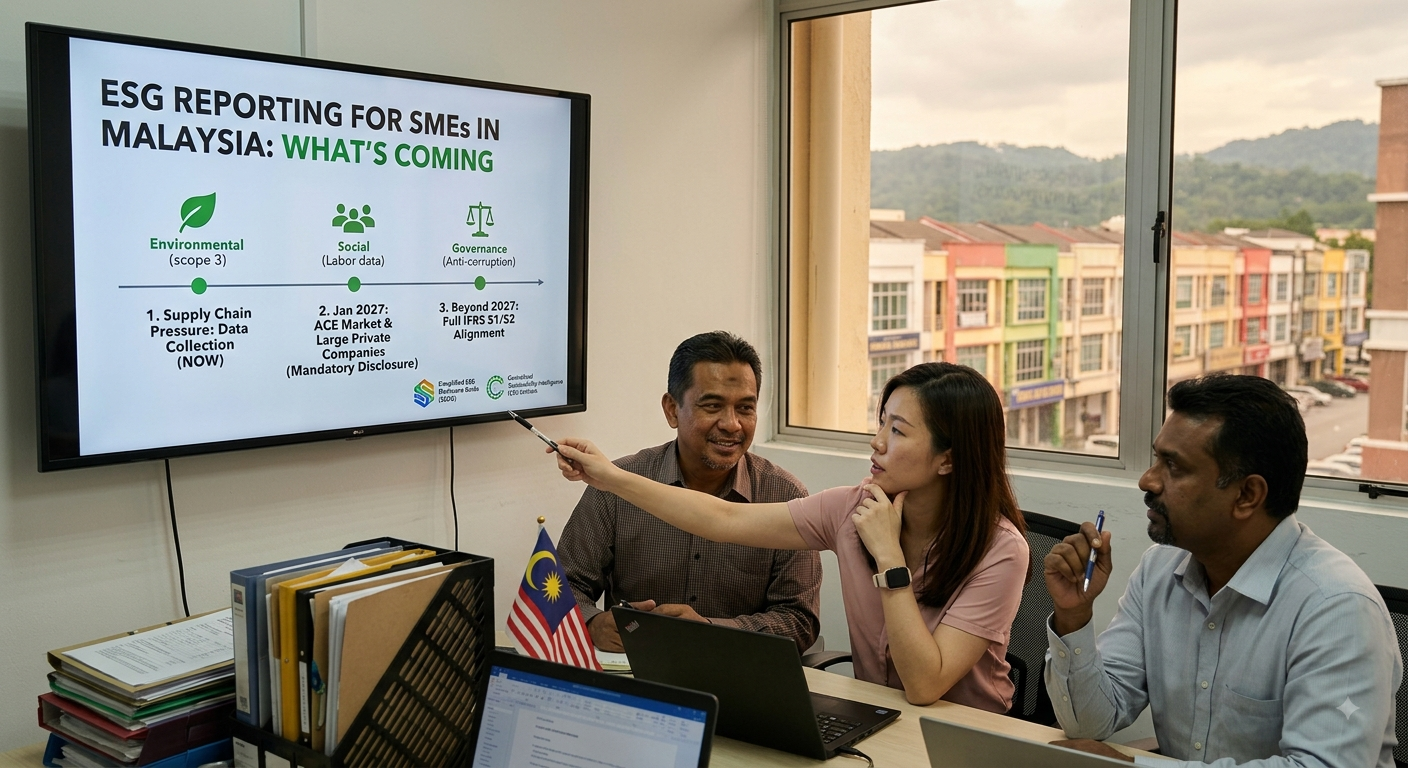
ESG Reporting for SMEs in Malaysia: What’s Coming

Recent Posts